During melon planting, powdery mildew often occurs in melon. Powdery mildew is also commonly known as white hair. It is the most common and important air borne disease in melon production. It can occur from seedling stage to adult stage. Generally, it occurs most seriously after entering the middle and late stage. If it is not prevented in time, the yield of melon will be reduced by 20%, and the serious one can reach more than 50%, Moreover, the maturity and sugar content of melon will be greatly affected. Therefore, prevention and control measures should be taken in time.
Melon powdery mildew
When powdery mildew occurs, it mainly damages melon leaves, and when it is serious, it will also damage petioles and stems. At the beginning, yellow chlorotic spots appear on the leaf surface, and white small powder spots appear on the back and back. The front chlorotic of the leaf | has irregular yellow spots. The small white powder spots gradually expand into large white powder spots, which are scattered on the leaf surface. Later, multiple disease spots fuse with each other, causing the leaf surface to be covered with white powder, the disease spots change from white to gray white, and the seriously ill leaves turn yellow, curl or dry early. In the later stage, small black spots can be seen in the white powder layer, that is, the pathogen has a sexual state - closed capsule.
Symptoms of severe powdery mildew
The pathogen of powdery mildew is not very easy to understand for our growers. Let's not talk about it here. Let's talk about the transmission route and incidence conditions of powdery mildew.
The bacteria in the southern and Northern protected areas can grow conidia asexually and spread on melons. In the open field in the north, conidia or ascospores are produced when the conditions are suitable. They are transmitted by air flow, rain and water droplets for initial infection and repeated reinfection. It occurs generally from June to October in production. The bacteria are resistant to drying, and will appear alternately under high temperature drying and high humidity conditions, which is conducive to the expansion of the disease.
Initial symptoms of powdery mildew
The growth temperature of bacteria is between 10 ~ 30 ° C, and the suitable temperature is 20 ~ 25 ° C. Conidia can germinate when the relative humidity is 25% - 85%, and the relative humidity is 45% - 75%. The disease spreads quickly. From April to May every year, the outside temperature rises rapidly, windy and dry, and the indoor humidity is high. When melon is growing, its powdery mildew is very easy to occur in a large area. It is observed that during this period, there are many cloudy days, insufficient light, excessive watering, high indoor humidity, partial application of nitrogen fertilizer, vigorous growth of plants, and heavy disease in the field, which is difficult to remove.
① Melon varieties resistant to powdery mildew were selected
Such as Zetian No. 1, Longtian No. 1, Longtian No. 4 F1, nayilu reticulated melon, Elizabeth, milong, Zhongtian No. 1, lanfengza No. 1, Monalisa, Alice, qitiancrisp, Haimi No. 2, Huanghe melon, Chunli, luhoutian No. 4, Wuxiang, Yongtian No. 2, Jingyu No. 1, Jingyu 268, Xiangyu melon, reticulated melon, xuewa thin skinned melon, etc.
② Seed soaking disinfection it is recommended that seeds be soaked in warm water at 55 ° C for 15 minutes to kill powdery mildew on seeds.
③ Cultivate disease-free and strong seedlings
Select the loam that has not planted melon, watermelon and other melon crops for more than 3 years as the seedling bed, and disinfect the bed soil with 50% carbendazim powder. If possible, use soilless seedling raising. After sowing, keep the seedling bed above 18 ° C and the humidity below 60%. If the humidity of the seedling bed is high, sprinkle a small amount of plant ash and reduce the humidity by ventilation. Refine the seedlings 7 ~ 10 days before planting, and plant disease-free seedlings.
④ Clean the garden solar greenhouse in time after the first crop is harvested, weed the melon in time during the growth period, remove the diseased leaves in time and burn them outside the field.
⑤ Fumigation disinfection
Before planting, the shed shall be disinfected and sterilized. 0.3KG sulfur yellow and an appropriate amount of sawdust shall be stacked in 5 places per 100 square meters. After ignition, it shall be smoked day and night, and then smoked once every three days to kill powdery mildew in the shed.
⑥ Scientific management to enhance the resistance of melon to Powdery Mildew
Using the soil testing and formula fertilization technology of melon, apply enough base fertilizer, especially the rotten organic fertilizer or compound fertilizer, and rake deeply and finely; Reasonable close planting, timely pruning and branching, strengthening ventilation and light transmission, timely topdressing in the middle of growth, especially phosphorus and potassium fertilizer, make good use of leaf fertilizer, cultivate strong branches and vines, enhance population disease resistance, and reasonably regulate temperature and humidity.
First of all, irrigation should be scientific and timely, but it should be mastered that it should not be poured in cloudy days, sunny days, afternoon, morning, big water, small water, cold water, warm water, open water and dark water, that is, under film irrigation.
The second is to release air in time, release air for 1 hour in the morning, reduce the humidity in the shed, and then close it immediately; When the temperature rises to 33 ° C, vent again to reduce the shed temperature to 20 ~ 25 ° C and the relative humidity to 60% ~ 70%, and then close the air outlet; When the injury is late, continue to let out the air to keep the humidity at about 70%, and then close the air outlet.
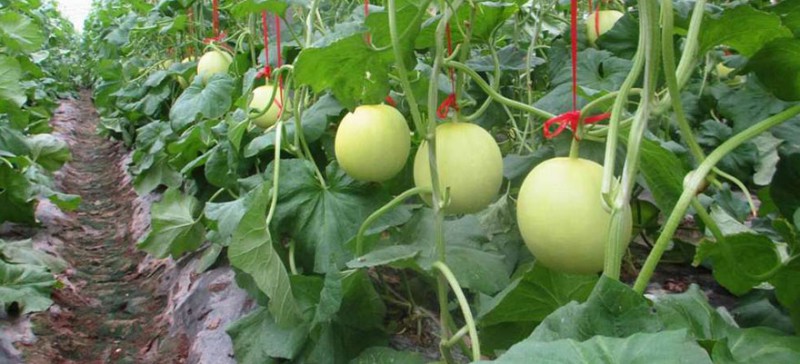
Melon planting
Although the humidity rose to more than 85% in the second half of the night, it was unfavorable to powdery mildew because the temperature fell to 12 ~ 13 ° C. After watering, close the air outlet to raise the temperature to 32 ° C and maintain it for 1 ~ 2 hours, and then release air to reduce humidity. If the temperature and humidity are well regulated, the disease will not occur.
⑧ Powdery mildew should be mainly prevented in dry years
Melon powdery mildew will occur in a large area after heavy fog or cloudy days in the middle and late growth stage of melon. The key of prevention and control technology is to spray medicine immediately after rain and fog. In production, it is recommended to spray 15 days earlier than the onset of normal years for protection. You can choose 3000 ~ 4000 times of 10% hexazolol emulsion, 900 times of 10% Difenoconazole microemulsion, or 800 ~ 1000 times of 25% acetoazol suspension for prevention, once every 10 days.
Melon planting
When the central diseased plant appears in the shed, it is recommended to immediately spray 800 times of 1% Osthol aqueous solution, or 800 ~ 1000 times of 20% oxazole ester suspension, or 1500 times of 25% pyrazole ether ester emulsion, or 120 times of 4% tetrafluoroetherazole water emulsion or 75% oxime bacteria ▪ 3000 times liquid of the water dispersible granules of the water was used to spray the leaves evenly and control the powdery mildew at the occurrence stage.